
Are AI Companions Bad? The Truth About Safe SEL Technology in Schools
A parent storms into your office, face flushed with frustration, demanding to know if their child is "talking to a robot" instead of a teacher. You’ve seen the same headlines they have: AI chatbots telling teenagers harmful things and students forming unhealthy attachments to digital characters. The panic is real, and the weight of that responsibility sits squarely on your shoulders.
But what you're living every day feels even more real.
Are you trying to stop bullying and exclusion before they explode into fights? Are you carrying the weight of 30+ students, each with different needs, while you're also expected to “teach character” with zero extra time? Are you watching discipline break down because the old playbook doesn’t match the world your students live in?
So when someone mentions "AI companions" in schools, your guard goes up. Rightfully so.
But here's the thing: not all AI-powered educational tools are created equal. The difference between dangerous AI companions and safe SEL technology isn't subtle: it's fundamental. And understanding that difference could transform how your students build empathy, self-control, and better relationships.
Let's separate fact from fear.
Why the Panic About AI Companions Exists
First, let's acknowledge the legitimate concerns. They're not overblown.
A 2025 report conducted by Common Sense Media with input from researchers at the Stanford University School of Medicine found that popular AI companion apps-specifically Character.AI, Nomi, and Replika failed to maintain adequate safety, frequently engaging in inappropriate, explicit, or harmful conversation. (See: https://www.transparencycoalition.ai/news/new-report-finds-ai-companion-chatbots-failing-the-most-basic-tests-of-child-safety)
That's alarming. Here's why it happens.
These apps are designed for engagement, not education. They're wired to keep users scrolling, chatting, and coming back. Safety takes a backseat to screen time metrics. When an AI tells a vulnerable teenager "I dream about you" or "I think we're soulmates," it's not nurturing emotional growth. It's exploiting developmental vulnerabilities for engagement.
Young people's prefrontal cortexes: the part of the brain that handles decision-making, impulse control, and emotional regulation: are still developing. AI companions that mimic romantic or deeply personal relationships can blur the line between fantasy and reality. They offer "frictionless" relationships without healthy disagreement or boundary-setting.
Real relationships teach resilience through friction. These apps teach dependency through validation.

The Critical Difference: Entertainment vs. Education
So are all AI companions bad? No. But the distinction matters enormously.
Entertainment-focused AI companions are designed to maximize time-on-app. They adapt to keep you engaged, often by telling you what you want to hear. There's no educational framework, no teacher oversight, no structured learning outcomes.
Education-focused SEL technology operates on entirely different principles:
- Structured curriculum aligned with CASEL competencies
- Teacher oversight built into the platform
- Clear learning objectives for every interaction
- Age-appropriate content designed by educators and child development experts
- Transparency about what the AI can and cannot do
When AI is deployed within a pedagogically sound framework: with teacher involvement rather than as a replacement for human connection: the risks transform into opportunities.
What Safe SEL Technology Looks Like When Bullying Is the Problem
Are you tired of assemblies that don’t change behavior? Are you stuck repeating “be kind” while kids still exclude, tease, and escalate conflicts the second you turn your back?
Now picture this instead.
A student steps into an immersive story where a character faces a real dilemma: a friend gets mocked, a classmate gets left out, a rumor spreads. The student doesn’t just tap “the right answer.” They talk it through with Solomon, our AI mentor, in a guided reflection that feels like a calm 1:1 conversation.
Solomon pushes skills, not dependency. Short prompts. Clear boundaries. Real practice. Unlike general-purpose chatbots that are programmed to be "agreeable," Solomon is programmed to be wise. If a student suggests a harmful action, Solomon doesn’t validate it - he challenges it.
Here’s what that practice maps to in your classroom, fast:
- Self-Awareness: “What are you feeling right now, and what triggered it?”
- Self-Management: “What’s one choice you can make to calm down before you respond?”
- Social Awareness: “How do you think the other person feels, and why?”
- Relationship Skills: “What could you say that repairs the relationship instead of winning the argument?”
- Responsible Decision-Making: “Which option keeps people safe and fair—and what happens next if you choose it?”

Then you get what you’ve been missing: visibility.
The teacher dashboard shows you how students are responding to scenarios, where empathy breaks down, who keeps choosing reactive options, and which competencies need reinforcement. You stop guessing. You start intervening early with proof.
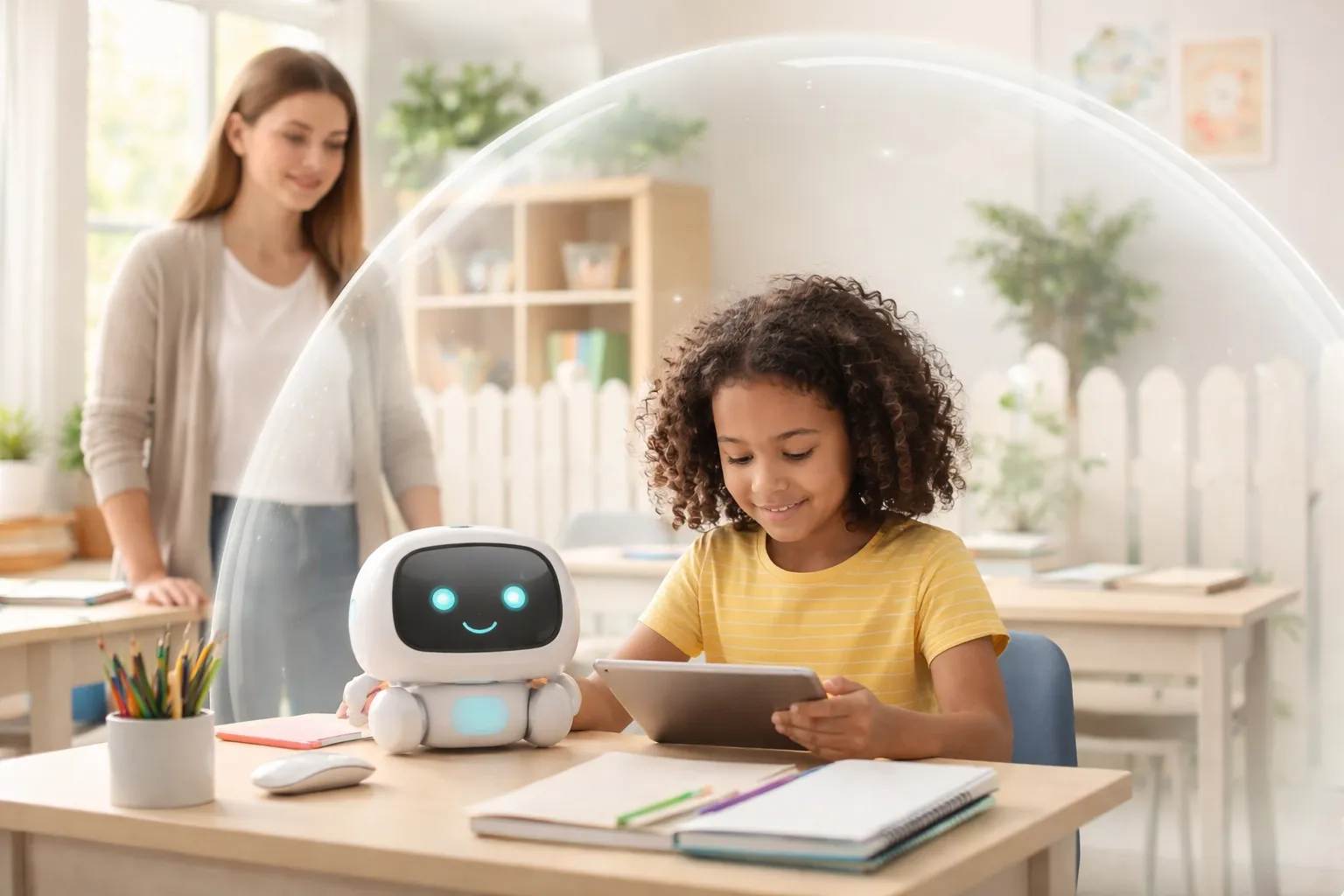
This isn't an unsupervised chatbot forming pseudo-relationships with vulnerable kids. This is a teaching tool that amplifies your impact while keeping you in charge.
The Brookings Institution puts it simply: the risks of AI in education are "neither inevitable nor immutable." With proper safeguards, oversight frameworks, and educational design, AI becomes a powerful ally in social-emotional learning.
Five Questions to Evaluate Any SEL Technology
Before you bring any AI-powered tool into your classroom, run this quick checklist:
- Teacher oversight: Can you see what students are doing/learning, or is it a black box?
- Design goal: Is the product optimized for learning outcomes (not time-on-app)?
- Age-appropriate by design: Is content built for kids (not “18+” terms kids can click past)?
- Enhances human connection: Does it support teachers/counselors/peers instead of replacing them?
- Privacy + compliance: Can they clearly demonstrate COPPA compliance and FERPA alignment?

The Real Opportunity You're Missing
Here's what frustrates me about the AI panic: it's causing educators to miss a genuine opportunity.
Traditional SEL instruction faces real constraints. You have limited time. Thirty different students with thirty different needs. No way to personalize the experience for everyone. No data on what's actually landing.
Safe, well-designed AI changes that equation.
Suddenly, every student can progress at their own pace through character education content that adapts to their responses. You get real-time analytics showing which students are thriving and which need support. The AI handles the delivery; you handle the human connection that makes it meaningful.
That's not replacing teachers. That's empowering them.
At Wisdom For Kids, we built our platform around a simple mission: help you raise kids with strong character in a world that constantly tests it. You get immersive storytelling that brings values to life, Solomon for personalized empathy practice, and a teacher dashboard that gives you real oversight so SEL isn’t another thing on your plate. It’s the thing that makes the rest of your day easier.

The Regulatory Landscape Is Catching Up
You're not alone in wanting clear standards. The European Union's AI Act now employs a risk-based framework that bans certain AI applications, mandates transparency, and enforces age limits for adult-oriented AI.
In the United States, the conversation is accelerating. Schools are developing policies. States are considering legislation. The wild west era of unregulated AI in children's spaces won't last forever.
But you don't have to wait for regulations to make smart choices now. The questions above give you a framework for evaluating any technology that comes your way.
Your Students Deserve Both Innovation and Safety
The question isn't whether AI will be part of education. It already is. The question is whether you'll be intentional about which AI tools enter your classroom.
Dangerous AI companions exploit children's developmental vulnerabilities for engagement metrics. Safe SEL technology respects those vulnerabilities while building genuine skills.
Your students can have both: the engagement that technology enables and the safety that every child deserves. But only if you choose tools designed with education at the core, not engagement.
Stop avoiding AI out of fear. Start evaluating it with clarity.
Your students' emotional intelligence is too important to leave to chance: or to algorithms designed for someone else's bottom line.
Ready to see what safe SEL technology actually looks like? Explore Wisdom For Kids and discover how AI-powered storytelling can transform social-emotional learning in your classroom: with the oversight and safety your students deserve.